
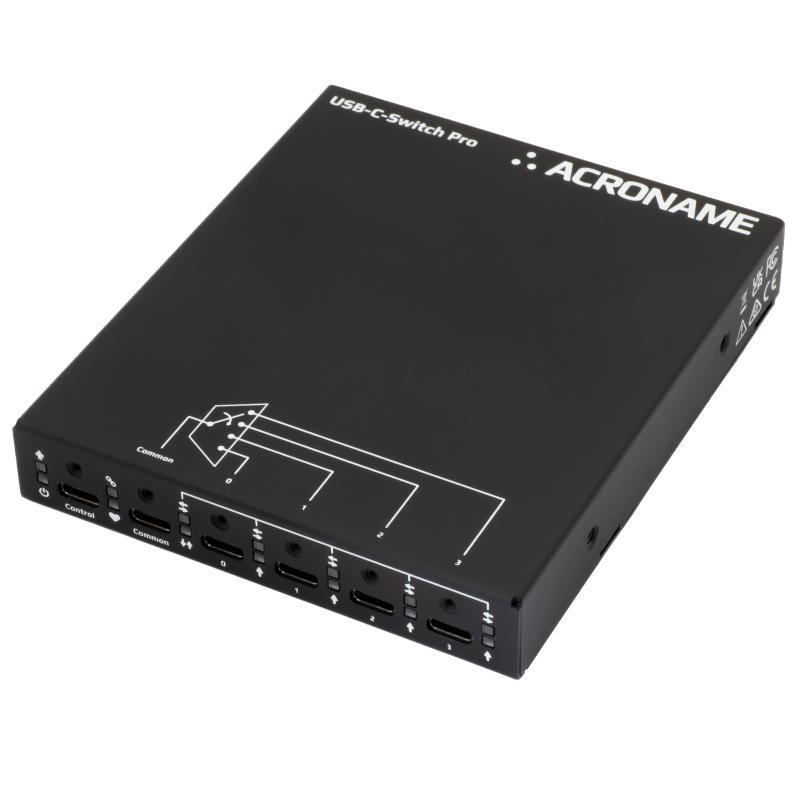
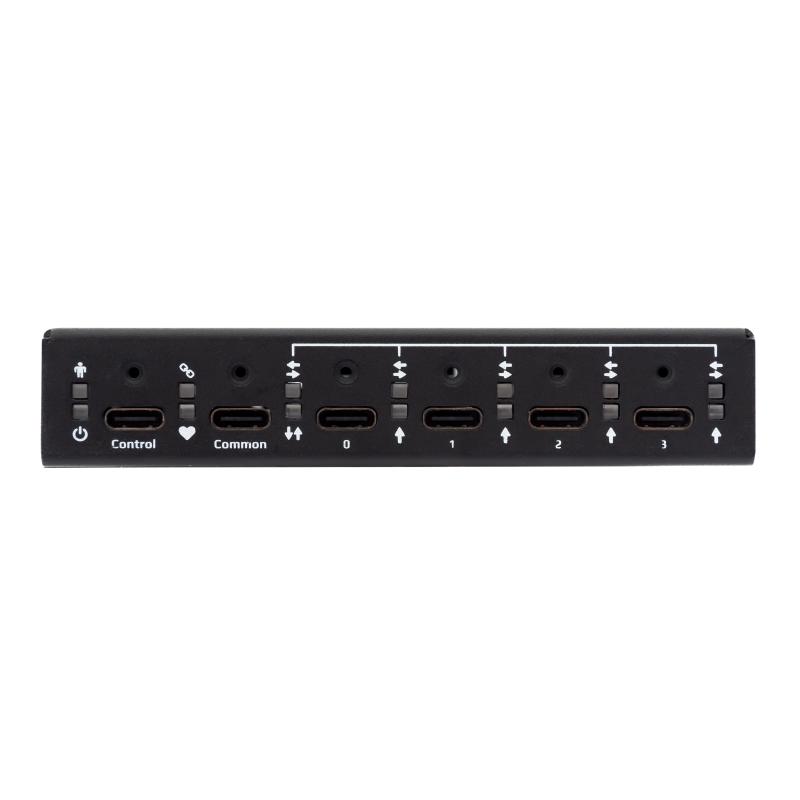
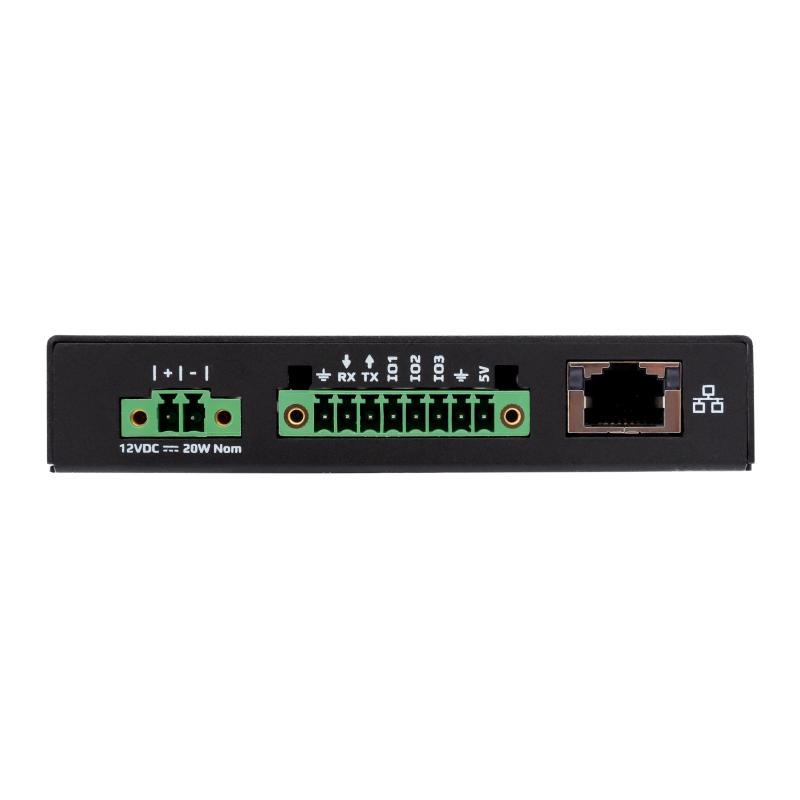
The USB-C-Switch Pro is a managed USB-C 1:4 / 4:1 port selector and multiplexer switch designed for automated device testing, validation, and A/V USB-C switching applications.
OVERVIEW
The USB-C-Switch Pro is an industrial USB4 port selector and multiplexer designed for maximum control and flexibility. The USB-C-Switch Pro lets developers and engineers validate, control, and test the limits of devices built on the USB Power Delivery Extended Power Range (EPR) and USB-C specification at speeds up to 40 Gbps and power levels up to 240 W. Unlike a hub, the USB-C-Switch Pro directly connects and redrives signals between a common port and one of four mux channels, appearing like a cable to connected devices. In the professional A/V space, automatic host switching brings simple Bring-Your-Own-Meeting (BYOM) solutions to complex conference room setups. Simple software APIs allow control, monitoring, and automation of all port functions, including signal routing, cable flip emulation, PD message logging, and real-time voltage and current measurements. The cross-platform HubTool application, built-in web interface, and multi-language BrainStem API are available to help explore device capabilities and control everything in your USB-C life.
Discover Built-In Features:
- USB4 40 Gbps Switching
- 240 W USB-PD EPR
- DisplayPort 2.1 Alt Mode (up to 2 x 8K@120 Hz) video pass through
- Cable Flip Emulation & Detection
- PD Message Logging, Decoding & Injection
- Split Mode Signal Routing
- Keep-Alive Charging (KAC)
- Per-Port Voltage & Current Measurement
- Automatic Host Switching
- ±15kV ESD protection (Industrial-Grade Build)
Extend the Capabilities With Add-on Features:
Universal Orientation Cable (UOC) Pair the USB-C-Switch Pro with Acroname's patented Universal Orientation Cables to enable fully automated cable flip testing without touching the cable. Available in two variants: C67-USBC-UOC for devices with shorted USB 2.0 sides and C70-USBC-UOC for devices with muxed USB 2.0 sides. learn more >
DIN Rail Mount Kit Mount the USB-C-Switch Pro on standard DIN rails for factory floor, lab, and rack installations. learn more >
External AC to DC Power Supply Acroname's recommended power supply for the 12 V DC input, freeing the Control Port for dedicated BrainStem communication. learn more >
Industrial Grade Reliability
The USB-C-Switch Pro is built for the most demanding conditions when failure isn't an option. With a rugged steel enclosure, ±15kV ESD protection (IEC61000-4-2 level 4), screw-retention USB-C connectors, and DIN rail mountability, it is ready for the harshest of factory floors, device farms, laboratories, or CEO-laden conference rooms. Active SuperSpeed redrivers on the Common and Mux ports compensate for cable loss, ensuring signal integrity across the full USB4 40 Gbps data path.
PD Message Logging, Decoding & Injection
We don't just let you watch USB Power Delivery negotiations happen…we let you get inside them.
The USB-C-Switch Pro gives you deep visibility into PD conversations between connected devices. Log, decode, and inject USB-PD messages in real time to understand exactly how devices negotiate power contracts, including PPS, AVS, and the full 240 W EPR specification.
But it goes beyond PD. The switch also captures and injects SBU and DisplayPort Aux traffic, giving you complete insight into alt mode signaling. Whether you're debugging a failed negotiation, validating compliance, or reverse-engineering a third-party device's behavior, the USB-C-Switch Pro puts you in control of the conversation between devices.
This is one of the features that separates us from the competition. Other switches let you route signals. Ours lets you understand them.
Cable Flip Testing
USB-C-Switch Pro allows automated testing of both sides of a USB-C receptacle when used with our specialized Universal Orientation Cables (UOCs).
The switch can programmatically invert signal routing so that side A of the common port connects to side B of the mux port (and vice versa), emulating a physical cable flip without anyone touching the cable. It also supports auto-flip, so it can automatically detect and correct orientation mismatches between the common and mux sides without manual intervention.
Combined with UOCs, you can fully automate orientation testing across hundreds or thousands of cycles. Say goodbye to walking over to the device and flipping cables by hand.
Split Mode
Our Split Mode feature gives you a level of signal routing control you won't find anywhere else. Instead of routing all signals from the common port to a single mux port, Split Mode lets you independently assign each signal group to different mux ports or disable them entirely:
- VBUS (power)
- SuperSpeed (TX/RX pairs)
- High Speed (D+/D-)
- CC1, CC2 (configuration channel)
- SBU1, SBU2 (sideband use)
Why does this matter?
It enables test configurations that would otherwise require multiple pieces of equipment. Route power through one mux port while sending data through another. Isolate CC lines for PD debugging. Test how a device responds when individual signal groups connect or disconnect independently. Split Mode opens up scenarios that most engineers didn't think were possible with a single piece of hardware.
Note: Keep-Alive Charging is automatically disabled when Split Mode is active.
Control Port & Connectivity
What do you do when you need access to your switch's internal controller but have all of your ports in use? With the USB-C-Switch Pro, you don't have to unplug a port or undo your test setup. Our switch has a dedicated Control Port for access to its control function, completely independent of the common and mux ports.
The Control Port is a dedicated high-speed USB 2.0 connection for BrainStem control and device power. No other USB traffic flows on this connection, so you'll always have access to the switch's controller regardless of what's connected to the common and mux ports.
But the Control Port is just one option. The USB-C-Switch Pro gives you more ways to connect than any switch on the market:
- USB-C Control Port for direct, always-available BrainStem access
- Ethernet for remote and networked control (DHCP or static IP)
- RS-232 for integration with AV control systems (Extron compatible) and legacy automation
- I2C for controlling peripherals and custom integrations via the expansion connector
- Web Interface for browser-based control and monitoring with zero software installation (beta)
- GPIO for hardware port selection via the expansion connector without a software host
With BrainStem APIs available for Python, C++, .NET, and LabVIEW, plus a RESTful interface, you can integrate the USB-C-Switch Pro into virtually any test automation framework or control system.
Let's break it down. You have the Control Port for dedicated access, Ethernet for remote operation, RS-232 for AV integration, and a built-in web interface for quick browser-based control. That means whether you're at the bench, across the building, or on the other side of the world, you have full control of your switch.
Power Input
The USB-C-Switch Pro can be powered two ways, and we've made both of them simple.
Control Port Power: The dedicated Control Port provides 5 V, 3 A to power the switch. One cable for both control and power. It's the simplest setup for getting started.
12 V DC Input: A pluggable Euro-style terminal block on the rear panel accepts 12 VDC (20 W nominal). This frees up the Control Port for dedicated BrainStem communication and is the preferred option for permanent installations. We recommend Acroname's external AC to DC power supply, or you can use any compatible third-party 12 V DC supply.
Here's an important distinction: because the USB-C-Switch Pro is a signal multiplexer and not a hub, it does not source power to connected devices from its own supply. Power delivery between the host and device passes through directly, up to the full 240 W EPR specification. The devices on either end handle their own power negotiation. The switch just makes sure it gets there.
Individual Port Control (Turn Port Functions On/Off)
In addition to switching between mux ports, our USB-C-Switch Pro also allows you to enable and disable individual signal functions on each port:
- SuperSpeed (SS) data
- High Speed (HS) data
- CC / VCONN configuration and power role lines
- SBU sideband signals
- VBUS power
This allows our switch to test a device using only USB 2.0, only USB 3.2, or any other combination of signal groups. Want to verify a device falls back gracefully when SuperSpeed is unavailable? Disable SS and test on USB 2.0 only. Need to see how a device responds to a power-only connection? Disconnect data lines and keep VBUS active. Want to emulate a cable unplug without physically touching anything? Disable all signal groups programmatically.
This granularity of control allows engineers to test hundreds of different configurations or run hundreds to thousands of plug-and-unplug cycles to find intermittent connection issues or validate long-term durability.
Say goodbye to spending hours trying to replicate problems or testing across various protocol versions. Get the USB-C-Switch Pro and use software to automate those tasks instead.
240 W USB-PD EPR Pass-Through
This is a feature that separates us from the competition. The USB-C-Switch Pro supports the full USB Power Delivery Extended Power Range (EPR) specification, passing up to 240 W between connected devices. That includes:
- PPS (Programmable Power Supply) for fine-grained voltage stepping
- AVS (Adjustable Voltage Supply) for high-voltage applications
- Standard PDO contracts at all voltage rails
Because the switch passes power through transparently, with devices negotiating directly with each other, you get true real-world power delivery behavior during testing. Per-port voltage and current measurements on VBUS and CC lines let you monitor exactly what's being negotiated and delivered in real time.
Important: When using EPR-capable cables, always ensure that both cables in a host-device connection support 240 W. EPR sources are unaware of the distal cable and will provide power based on the e-marker of the proximal cable only.
USB4 40 Gbps (and backward compatible)
The USB-C-Switch Pro is compatible with USB4 at the full 40 Gbps data rate and all previous USB generations, including USB 3.2 Gen2 (10 Gbps) and USB 2.0. This allows for maximum compatibility with current and previous-generation devices.
Why is this important?
Each generation of USB connectivity has delivered increased speed and capability. USB4 provides data transfer at 40 Gbps, four times faster than USB 3.2 Gen1 (5 Gbps) and double USB 3.2 Gen2 (10 Gbps).
When you're performing device validation, you need the ability to test across all USB speed generations and make sure your device is backward compatible. With our USB-C-Switch Pro, you can test under each specific USB generation's protocols. Active SuperSpeed redrivers on both the common and mux ports compensate for signal loss, maintaining signal integrity across the full speed range.
DisplayPort Alt Mode
The USB-C-Switch Pro routes DisplayPort 2.1 Alt Mode signals at UHBR20 speeds, supporting resolutions up to 2 x 8K@120 Hz. Configurable lane modes include:
- 4-lane DisplayPort (common side or mux side to host)
- 2-lane DisplayPort with USB 3.1 (both orientations, including inverted)
- USB4 / Thunderbolt (including inverted)
Why is this important?
More and more devices rely on a single USB-C cable to carry video, data, and power simultaneously. The USB-C-Switch Pro lets you validate display output across every supported Alt Mode configuration without rewiring. In conference room setups, DisplayPort routing happens automatically during host switching. In test environments, you can cycle through every lane configuration programmatically.
Whether you're building a dock, a monitor, a laptop, or a conference room system, the USB-C-Switch Pro gives you the tools to validate that your DisplayPort implementation works across every supported mode.
Keep-Alive Charging (KAC)
Keep-Alive Charging is a built-in feature that provides 5 V at 500 mA to inactive mux ports, keeping connected devices charged and ready even when they aren't the active connection.
When would this matter?
In a device testing lab, you might have four phones connected to the switch but only test one at a time. Without KAC, the idle phones drain their batteries while waiting. With KAC, they stay charged and ready for their turn. In a conference room, a visitor's laptop stays topped up on an inactive port until it becomes the active host.
KAC includes built-in thermal and overcurrent protection. If a fault occurs, you'll need to disable and re-enable KAC to restore it. It does not provide USB-PD, BC1.2, or QuickCharge, so it won't interfere with power delivery testing on the active port.
Note: KAC is automatically disabled when Split Mode is active.
Painless Presentations
With Acroname's automatic host-switching technology, when a user's laptop is plugged into the USB-C-Switch Pro, all connected peripherals, including displays, cameras, room audio, network, and power, automatically switch from the conference room PC to that user's machine through a single USB-C cable. When the laptop disconnects, peripherals reconnect to the room PC automatically. No software to install. No buttons to press. Just plug in and present.
Cable Flipping with UOC
One of the most exciting USB advances to come with USB-C is the freedom to plug a cable in the "right" way the first time. Because you can plug in a USB-C cable either way! What a relief from always guessing the wrong way on the first try.
Did you know, though, that while you can plug a USB-C cable in either way, there remains a defined orientation of the cable? Each USB-C cable has an "A" and a "B" side. These mirror each other in some ways, but not exactly. The orientation of a cable can make a difference depending on your intended use, because different groups of pins are accessed to achieve the desired function for power or data transfer.
Why is this important?
When you perform device testing and validation, you need to prove that your device can operate with a variety of USB-C pin configurations. The end user of your device may want to perform tasks that are completely within the scope of USB-C but outside the day-to-day norms you'd expect. Your device better be able to handle what's expected of it.
How do you ensure that a device is fully functional for USB-C? Until recently, you'd have to run a cycle of tests in one orientation, manually flip every cable for your devices under test, and then run that same cycle of tests again. That posed some serious problems for productivity, test consistency, and sanity.
We designed and patented the ability to programmatically flip and test USB-C orientations. While we can create a switch that commands a cable to flip without manually flipping it, we needed to design a cable without a defined orientation.
If you take a generic USB-C cable, plug it into our USB-C-Switch Pro, and use the API to command a cable flip, nothing will happen. The cable won't be able to "flip" because it has a defined, or set, orientation (A or B).
Our Universal Orientation Cable (UOC) solves this problem, so you can programmatically "flip" the cable to perform tests on both sides of a USB-C connector without touching the cable or restarting your device.
The UOC does not have a defined orientation until our USB-C-Switch Pro gives it one. Two variants are available for different device types:
- C70-USBC-UOC routes both CC lines and two HS pairs, designed for devices with muxed USB 2.0 sides
- C67-USBC-UOC routes both CC lines and one HS pair, designed for devices with shorted USB 2.0 sides
This feature allows you to unlock the full range of productivity and efficiency for testing your USB-C devices. Just plug, test, programmatically flip, and keep testing.
Happy testing!
Automotive Testing: CarPlay & Android Auto
The USB-C-Switch Pro is purpose-built for automotive head unit development and validation. Sequentially test a single head unit against multiple phones (both iOS and Android), or test a single phone against multiple head units, all without touching a cable.
How does it work?
Connect your test PC to the Control Port for BrainStem access. Connect a head unit to the common port. Plug up to four phones into the mux ports: iPhones, Android devices, or a mix. The BrainStem API lets you script automatic switching between devices, running through your entire test matrix unattended.
Combined with cable flip emulation, you can test both USB-C orientations on every device combination. Use PD message logging to debug charging issues between the head unit and phone. Automate plug-and-unplug cycles to validate connection reliability over hundreds of iterations. The USB-C-Switch Pro handles the complexity so your engineers can focus on the results.
Per-Port Voltage & Current Measurement
The USB-C-Switch Pro provides real-time electrical measurements across all ports, giving you complete visibility into what's happening on the wire:
Common Port:
- VBUS voltage and current
- CC1, CC2 voltage and current
- SBU1, SBU2 voltage
Mux Ports (0-3) and Control Port:
- VBUS voltage and current
- CC1, CC2 voltage
Use these measurements to monitor power negotiations in real time, validate that devices draw the correct current, detect anomalies in CC signaling, and verify SBU line behavior during Alt Mode operation. All measurements are accessible through the BrainStem API, HubTool, and the web interface (beta).
Unit Reset & Recovery
A reset button on the bottom of the unit provides two simple functions:
- Single press: Power cycles the device
- Double press within 5 seconds: Restores factory defaults
This means you can never permanently lock yourself out of the USB-C-Switch Pro, even if a misconfiguration makes it unreachable over the network. And no custom drivers are required on Windows, Linux, or macOS. The device is detected as a USB 2.0 high-speed device named "USBCSwitchPro" right out of the box.
- Supports USB Power Delivery Extended Power Range (EPR) up to 240 W including PPS and AVS
- USB4 (40 Gbps), USB 3.2 Gen2 (10 Gbps) and USB 2 switching
- DisplayPort 2.1 Alt Mode routing (1-4 lanes, UHBR20, up to 2 x 8k@120Hz)
- USB-PD, SBU, and DisplayPort Aux message logging, decoding, and injection
- Enable/Disable any port for automation Type-C hot-plug / unplug actions
- Automate type-C connector flip actions (using Acroname UOC cable)
- Monitor voltage, current on all ports
- Full control via USB Control port, Ethernet, I2C, RS-232, or port selection via GPIO
- Screw retention on all USB-C, DC power, and external IO ports
- TAA compliant
- 1 - USB-C-Switch Pro 4-port USB4 40Gbps 240 W EPR Switch
- 1 - USB-C male-to-male full featured e-marked cable 40Gbps, single screw single side, 1M C69-USBC-C
- 2 - USB-C male-to-male full featured e-marked cable 80Gbps, 0.3M
- 2 - Acroname Universal Orientation Cables (UOC), 0.7M 1x C67-USB-UOC 1x C70-USB-UOC
- 1 - 8 Position Terminal Block Plug
- 1 - Quick Start Guide
People Also Viewed
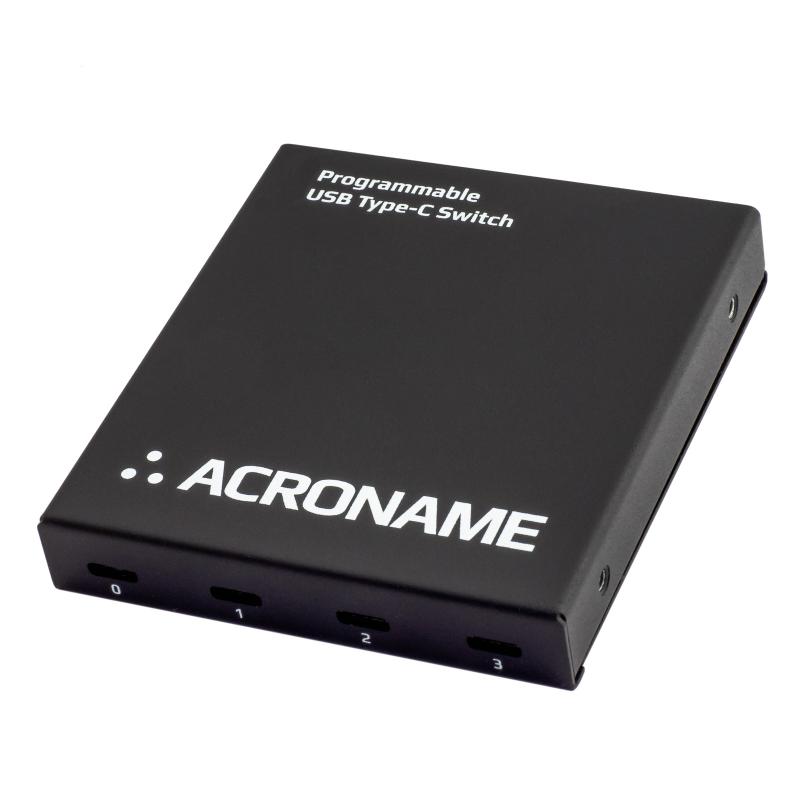
Automate port switching, hot-plug & type-C connector flips. Monitor Vbus & Vconn voltage & current.
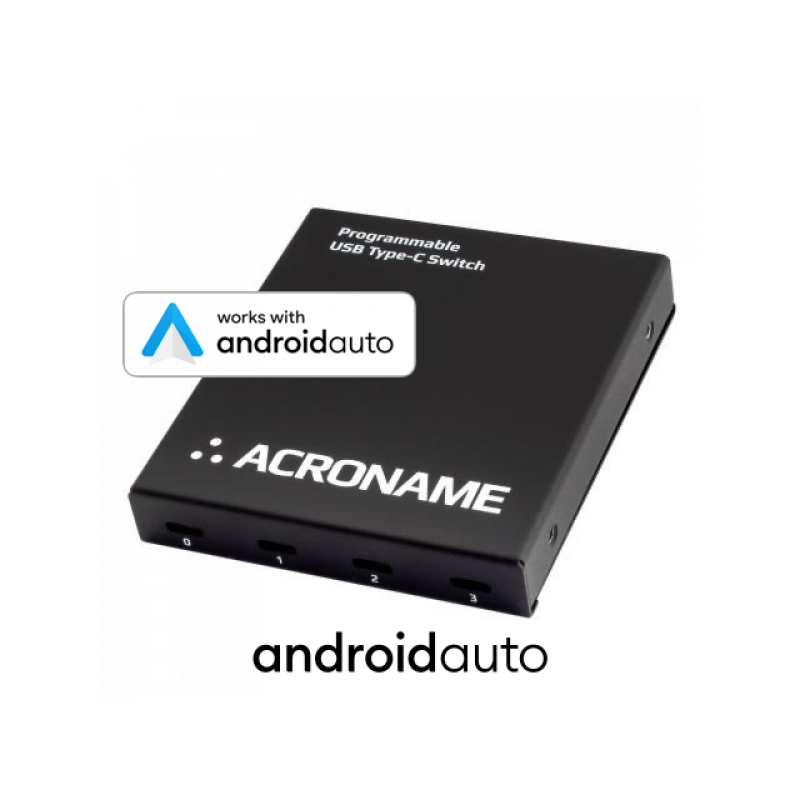
Everything needed to set up the connections required for the Android Auto connectivity validation and certification test. Combined with software from Google, this package has all the hardware needed to get started with Android Auto testing: the Redriver model USB-C-Switch, four (4) 3.28ft USB-C to C e-marked cables, and one 1.5ft USB-C to A cable.
Add New Review